

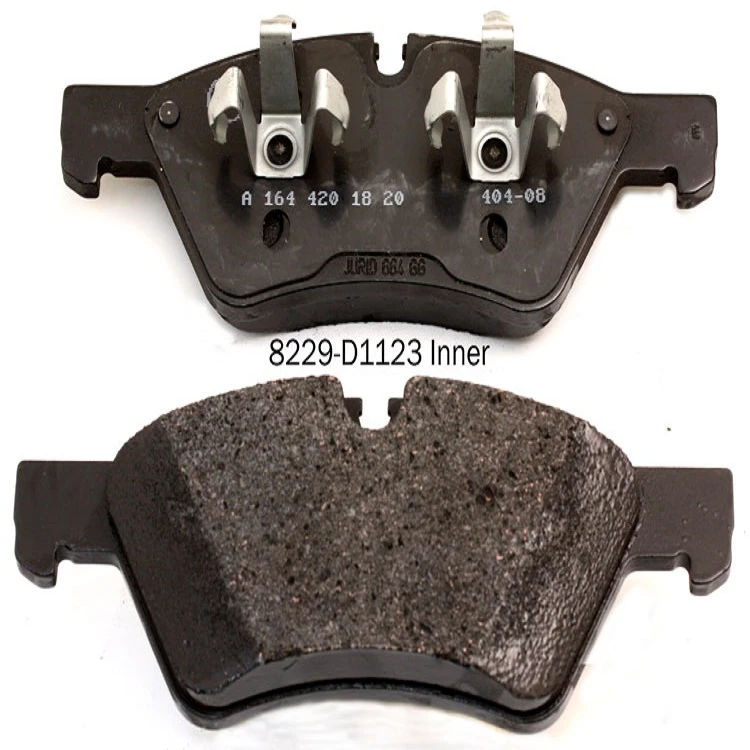
High Temperature Ceramic Brake Pads
High Temperature Ceramic Brake Pads are developed for passenger cars, SUVs, crossovers, and selected light commercial vehicles exposed to frequent braking or elevated brake temperatures.
Product Introduction
High Temperature Ceramic Brake Pads are developed for passenger cars, SUVs, crossovers, and selected light commercial vehicles exposed to frequent braking or elevated brake temperatures.
The ceramic-based friction material combines selected reinforcement fibers, fillers, abrasives, lubricants, and bonding components. The formulation is designed to balance thermal stability, friction consistency, wear control, noise behavior, and rotor compatibility.
For wholesalers, importers, distributors, and private-label brands, reliable brake pads require more than good initial performance. Consistent production, application coverage, quality verification, and stable supply are equally important.
Key Product Advantages
Designed for Elevated-Temperature Braking
During braking, vehicle kinetic energy is converted into heat at the pad-rotor interface. Repeated braking increases friction temperature and can affect friction behavior.
The formulation uses thermally stable components to help maintain predictable friction performance as temperature rises. Friction, fade and recovery, and wear performance can be evaluated through controlled testing according to the applicable product or customer specification.
Actual performance depends on the formulation, rotor, vehicle weight, brake-system design, and operating conditions.
Balanced Friction and Wear
Brake-pad performance results from the interaction of multiple material components. Reinforcement fibers provide structural support, while friction modifiers, fillers, abrasives, and lubricants influence friction response, wear, thermal behavior, and noise.
Formulations can therefore be adjusted for specific vehicle applications rather than relying on one universal compound.
Controlled Dust and Noise
Ceramic friction materials can help reduce visible brake dust compared with some conventional formulations and can provide favorable NVH characteristics when combined with suitable chamfers, slots, and shims.
Actual dust and noise levels depend on the complete brake system, rotor condition, installation, bedding, temperature, and driving environment. No friction material should be considered universally dust-free or noise-free.
Technical Specifications
|
Parameter |
Specification |
|
Product Type |
High Temperature Ceramic Disc Brake Pads |
|
Applications |
Passenger Cars, SUVs, Crossovers, Selected LCVs |
|
Axle Position |
Front / Rear, Application-Specific |
|
Friction Material |
Ceramic-Based Composite |
|
Reinforcement |
Fiber-Based Options |
|
Back Plate |
Application-Specific Steel |
|
Noise Control |
Chamfer / Slot / Shim Options |
|
Testing |
Friction, Wear, Dimensional & Quality Inspection |
|
Development |
OE Number / Sample / Drawing Based |
|
Customization |
Formula, Shim, Marking & Packaging |
|
Supply |
Wholesale / OEM / Private Label |
Specifications vary according to vehicle application and approved product requirements.
Quality Control & Batch Consistency
For aftermarket distributors, repeat-order consistency is critical. Approved raw-material specifications and controlled mixing, pressing, curing, finishing, and final inspection procedures are used to reduce variation between production batches.
Depending on the project, quality verification may include dimensional inspection, hardness, density, bonding strength, friction and wear evaluation, and dynamometer testing.
The factory operates 5 production lines, with annual production capacity of approximately 6 million sets and a product range covering 1,200+ applications. Engineering personnel support formulation development, product matching, and manufacturing improvement.
OEM & Private Label Support
Development can be based on:
• OE numbers and cross-reference requirements
• Customer samples or technical drawings
• Vehicle and brake-system information
• Friction-material requirements
• Shim, chamfer, slot, and wear-sensor specifications
• Private-label marking and packaging
For project evaluation, buyers can provide OE numbers, samples, drawings, target market, and estimated annual demand. This information helps determine the appropriate application specification before quotation and mass production.
Applications
Suitable for:
• Passenger cars
• SUVs and crossovers
• Urban stop-and-go vehicles
• Vehicles exposed to repeated braking
• Selected light commercial vehicles
• Automotive aftermarket distribution
• Private-label programs
FAQ
Q: Are these pads suitable for daily driving?
A: Yes, when correctly matched to the vehicle and brake system.
Q: Are they completely dust-free?
A: No. All friction materials generate wear particles. The formulation is designed to help control visible dust under suitable applications.
Q: Can you develop a specific OE application?
A: Yes. OE numbers, samples, drawings, and vehicle information can be used for application evaluation and development.
Q: Can you provide private-label packaging?
A: Yes. Product marking, labels, individual boxes, cartons, and packaging specifications can be customized.
Q: How is batch consistency controlled?
A: Approved material specifications and controlled production and inspection procedures are used to reduce variation between repeat orders.
Q: What is needed for a quotation?
A: Provide the OE number, vehicle application, axle position, target market, estimated volume, and any performance or packaging requirements.
Hot Tags: high temperature ceramic brake pads, China high temperature ceramic brake pads manufacturers, suppliers, Brake Pads and Discs for Hyundai I10, Brake Pads for Bmw, Front Brake Pads for Honda Jazz, Front Brake Pads for Jaguar Xf, Low Metallic Disc Brake Pads, Vans Brake Pads
You Might Also Like


Send Inquiry
