

Brake Pad Industry Knowledge Popularization: Interpreting the Core Component of Braking Systems
Among the numerous components of a car, brake pads, though small, are crucial for driving safety and form a key part of the braking system. Today, we will gain an in-depth understanding of knowledge related to brake pads.
I. Function and Working Principle of Brake Pads
The function of brake pads is to closely cooperate with brake discs or brake drums to generate friction torque, thereby slowing down or stopping the vehicle. When we step on the brake pedal, the braking force pushes the brake caliper through the brake fluid. The caliper then presses the brake pads tightly against the brake disc or brake drum, creating a torque opposite to the direction of the car's movement, thus slowing down or stopping the vehicle. Simply put, it is like the "safety brake" of a car; whether the car can stop in critical moments largely depends on the performance of the brake pads.
II. Composition and Structure of Brake Pads
Brake pads are mainly composed of a steel backing (shoe in drum brakes) and a lining. The lining further consists of a friction material layer, a heat insulation layer, and an adhesive layer.
• The steel backing is usually made of metal materials such as steel or aluminum alloy. It provides support for the brake pad, bears the pressure during braking, and ensures stability. Its surface is also treated with special processes like galvanizing and spraying to enhance corrosion resistance and wear resistance.
• The friction material layer is the core part, usually made of organic friction materials such as phenolic resin and aramid fiber. These materials ensure that the brake pads can generate sufficient friction during braking. To improve the friction coefficient and wear resistance, it may also contain metal particles or other fillers.
• The heat insulation layer generally uses materials with good thermal conductivity, such as glass fiber. Its main role is to prevent the brake pads from experiencing thermal fading at high temperatures and ensure stable and reliable braking performance.
• The adhesive layer uses an adhesive to firmly bond the friction material layer and the backing plate together.
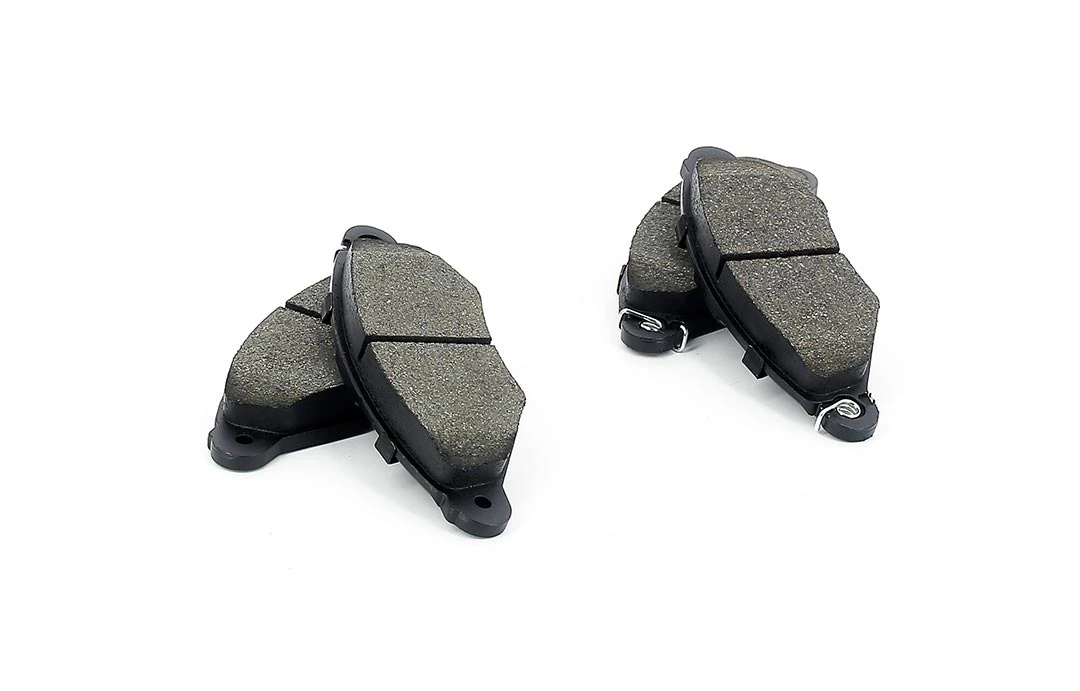
III. Classification of Brake Pads
(I) Classification by Type
1. Brake Pads for Disc Brakes: This is the most widely used type in current automobiles, working in conjunction with brake discs. Disc brakes have advantages such as fast heat dissipation, sensitive braking, and good stability, and are commonly used in sedans, SUVs, and other vehicle models.
2. Brake Shoes for Drum Brakes: Generally used in some trucks, buses, and partial low-end vehicle models. Drum brakes have lower costs but are slightly inferior to disc brakes in terms of heat dissipation and braking efficiency.
(II) Classification by Formula
1. Semi-Metallic Brake Pads: Containing 30% - 60% metal components, such as steel fibers, copper fibers, and iron powder, mixed with resin and friction modifiers. They have a relatively high friction coefficient (between 0.4 - 0.5), good high-temperature stability (able to withstand about 400°C), strong wear resistance, and a service life usually ranging from 50,000 to 80,000 kilometers. However, they cause slightly more wear to brake discs, may have hard spots at low temperatures, are prone to generating noise, and have a stiffer pedal feel.
2. Non-Metallic Brake Pads (Resin-Based Brake Pads): Using resin as a binder, mixed with non-metallic materials such as glass fiber, aramid fiber, and graphite. They have a moderate friction coefficient (approximately 0.3 - 0.4) but are prone to fading at high temperatures-their performance decreases significantly when the temperature exceeds 300°C. They wear quickly, have a short service life (generally 30,000 to 50,000 kilometers), but produce low noise during braking, have a softer pedal feel, offer better comfort, cause less wear to brake discs, and are relatively low in price. They are suitable for family cars used for short-distance urban commuting and driven with a gentle style.
3. Carbon Fiber Brake Pads: Made of materials such as carbon fiber and resin, they have advantages of light weight, high-temperature resistance, and stable friction coefficient. They are often used in high-performance sports cars or racing cars. However, their cost is relatively high, so they are rarely used in ordinary civilian vehicles.
4. Ceramic Fiber Brake Pads: Their core materials are ceramic fibers and ceramic powder, mixed with a small amount of metal (such as copper fiber) and resin. They have a stable friction coefficient (0.4 - 0.5), balanced performance at high and low temperatures, can withstand temperatures above 600°C with no obvious fading, wear very slowly, and have a maximum service life of over 80,000 to 100,000 kilometers. Moreover, they cause little wear to brake discs, produce almost no noise during braking, have a linear and smooth pedal feel, offer the best comfort, have good heat dissipation, and are not prone to generating brake dust (keeping wheel hubs cleaner). Although they are the most expensive, they have the best overall performance and are suitable for upgrading most family cars and scenarios with high requirements for braking quality.
IV. Performance Indicators of Brake Pads
1. Braking Performance: Refers to the braking capacity of brake pads under normal braking conditions (low braking temperature), i.e., the friction coefficient. A higher friction coefficient means better braking effect, but it is not the higher the better-stability and comfort also need to be considered.
2. Fading Performance: During continuous braking (e.g., on downhill mountain roads), the temperature of the brake system rises rapidly, which reduces the braking capacity of the brake pads and increases the braking distance. This phenomenon is called "fading". High-quality brake pads have a very low fading rate or even no fading, while some inferior products fade seriously and almost lose their braking capacity at high temperatures.
3. Recovery Performance: It refers to whether brake pads that have experienced high-temperature fading can quickly restore their original braking performance when the temperature drops, which is also an important indicator to measure the quality of brake pads. Brake pads with good recovery performance can restore their braking capacity in a short time, ensuring driving safety.
4. Wear: Refers to the wear condition of brake pads during use. Brake pads with low wear have a long service life, which can reduce the frequency of replacement and lower the use cost.
5. Noise: There are many factors causing braking noise, and brake pads are one of them. It is generally believed that brake pads with too high hardness are prone to generating noise. Noise not only affects the driving experience but may also be a sign of problems with the brake pads.
6. Others: There are also performance indicators such as shear strength, hardness, compression rate, thermal expansion, water absorption, and adhesion. These indicators affect the performance and service life of brake pads in different aspects.
V. How to Choose High-Quality Brake Pads
1. Check the Product Packaging: The packaging of high-quality brake pads should be intact. The anti-counterfeiting marks and packaging labels should be consistent with those on the brake pads, and the product model should match the content on the certificate of conformity. The packaging printing is usually clear, and the packaging box contains a certificate of conformity, production batch number, production date, etc.
2. Choose Formal Channels: Purchase from formal auto parts stores, 4S shops, or officially authorized distributors as much as possible to avoid buying counterfeit and shoddy products.
3. Refer to Brand and Reputation: Choose brake pads from well-known brands with a good market reputation. These brands usually have more guarantees in quality control and technological R&D. For example, the brake pads produced by Shandong Huaruifeng Machinery Co., Ltd. adopt advanced one-time molding molds to ensure product stability and consistency; the dust-free design keeps brake discs and wheel hubs as clean as new; shock-absorbing pads are also designed to reduce noise and vibration. Their friction performance is stable (with no noise) at different temperature stages, especially at high temperatures, and they have a long service life. In addition, they do not contain asbestos, use a copper-free formula, and have unique formula systems for sports cars and ambulances, which are recognized by many automobile manufacturers and users.
4. Pay Attention to After-Sales Guarantee: Priority should be given to products with after-sales guarantees and traceable product information. In this way, if problems occur during use, they can be solved in a timely manner, and safety is more guaranteed.
As a key component of the automobile braking system, the quality and performance of brake pads are directly related to driving safety. Understanding this industry knowledge about brake pads can help car owners make more informed decisions when choosing and using brake pads, ensuring safe travel.


