

A Complete Guide to Brake Pad Selection, Usage & Technological Upgrades: Shandong Huaruifeng Helps You Understand the Core of Braking Safety
As the "life-saving component" of an automobile's braking system, brake pad performance directly determines driving safety and experience. With the automotive industry shifting toward new energy and intelligence, the material selection, performance requirements, and replacement standards for brake pads are constantly evolving. Combining years of in-depth industry experience, Shandong Huaruifeng Machinery Co., Ltd. sorts out the core knowledge of brake pads to help with accurate selection and scientific maintenance.
I. Core Classification of Brake Pads: Material Determines Application Scenarios
Performance differences of brake pads stem from material formulations, with different types suited for various vehicle models and usage needs. The mainstream materials are categorized as follows:
• Semi-metallic Type: Containing metal fibers and particles, it boasts excellent temperature control and heat dissipation performance, making it the factory standard for most fuel vehicles. It is cost-effective (150-300 RMB per set) but prone to abnormal noise in low-temperature environments, with a relatively low friction coefficient (around 0.38) and a medium service life. Ideal for fuel vehicles frequently driven on highways.
• Low-metallic Type: With lower metal content than semi-metallic brake pads, it improves brake drum wear and braking noise issues, offering outstanding cost-performance ratio. However, its service life is slightly shorter than that of semi-metallic counterparts, suitable for budget-friendly household fuel vehicles.
• Ceramic Type: Made from ceramic fibers as the core raw material, cured with organic binders, it features high hardness, strong wear resistance, low dust generation, no noise, and environmental friendliness. Its thermal fade resistance far exceeds that of semi-metallic brake pads, with a service life 30% longer than ordinary models. It also does not corrode wheel hubs, making it the top choice for household vehicles (200-400 RMB per set) and highly recognized in European, American, and Japanese markets.
• Non-metallic Type (NAO): Adopting non-metallic fibers such as aramid and glass fiber, it has significant formulation differences. Some high-end products are specially developed for new energy vehicles, meeting the needs of low noise and stable friction coefficient, and have become one of the mainstream materials for electric vehicles.
• Carbon Fiber Type: It has excellent high-temperature resistance and thermal conductivity, high power absorption per unit area, low wear on brake discs, and a long service life. However, it is expensive and only used in racing cars, high-end sports cars, and aerospace fields.
Note: Asbestos-containing brake pads have been completely eliminated due to their carcinogenicity. Avoid non-standard models among unbranded products when purchasing.
II. Key Performance Parameters: Correct Selection is the Premise of Safety
When purchasing brake pads, core parameters must be precisely matched with the original vehicle to avoid braking failure or component wear. Focus on two key points:
• Friction Coefficient: Determines braking force, marked on the package (e.g., FF, GG, HH grades). For household sedans (1.2-1.8 tons), choose GG/FF grades with a coefficient of 0.35-0.45, balancing braking force and comfort; for SUVs/MPVs (1.8-2.5 tons), select HH grades with a coefficient of 0.40-0.50 to meet heavy-load braking needs. Avoid blindly pursuing high coefficients (e.g., racing-grade JJ grade), which may cause brake disc overheating, and do not choose low-coefficient products below 0.35, which pose a risk of weak braking.
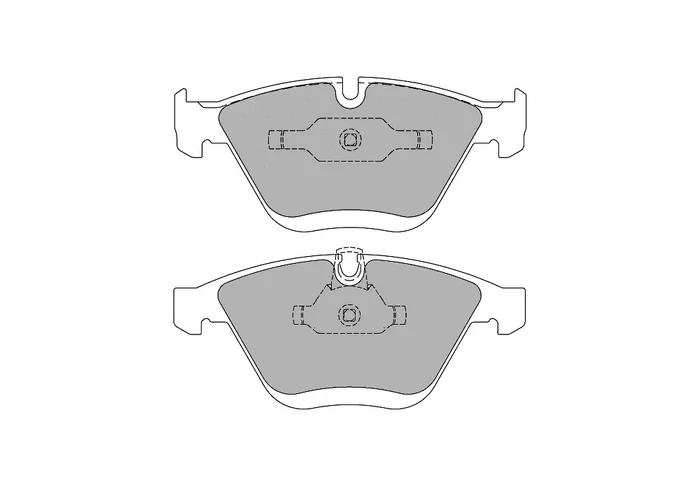
• Matching Specifications: Must match the vehicle's brake caliper type (single-piston/multi-piston), brake disc size, and metal backplate hole positions. Provide the "vehicle model year + displacement + drive mode" when purchasing to avoid universal models (which have reduced friction area and compromised performance).
• Auxiliary Parameters: Compression deformation (±30μm in cold state, ≤200μm in hot state) affects braking stroke and noise; porosity < 18% (12% recommended for electric vehicles) optimizes noise reduction performance. These parameters are also core identifiers of high-quality products.
III. Exclusive Requirements for New Energy Vehicles: New Upgrades in Brake Pad Technology
With the rising penetration rate of electric vehicles, their characteristics of fast acceleration, strong energy recovery, and low background noise put forward special requirements for brake pads:
• High-temperature Stability: When electric vehicles undergo continuous emergency braking, the temperature of brake pads can exceed 700℃. It is necessary to select NAO or ceramic brake pads with high-temperature resistant formulations to avoid a sharp drop in friction coefficient caused by resin decomposition.
• Low-noise Demand: Electric vehicles produce low driving noise, so creep noise and squeal during braking are more noticeable. Choose products with high compressibility and stable friction coefficients (AK test ≤ 0.38). Some products optimize low-temperature noise reduction through the design of noise reduction shims and double-sided adhesive.
• Compatibility with Energy Recovery: Conventional braking loads are small, so brake pads have a longer service life. The thickness of friction materials can be reduced by about 50% while ensuring service life, but sufficient friction area must be retained to avoid temperature concentration during emergency braking.
The low-noise and anti-corrosion ceramic brake pads developed by Shandong Huaruifeng for new energy vehicles not only meet the above requirements but also solve the corrosion problem in coastal areas through special coating technology, improving braking response speed by 25% and controlling noise below 60dB.
IV. Replacement Timing and Maintenance: 3 Warning Signs + 2 Standards
Brake pads should never be "used until the limit". Replace them immediately when the following signs appear to avoid safety hazards:
1. Abnormal Noise Warning: A squeaking metal friction sound during braking is an alarm signal that the wear indicator is in contact with the brake disc. At this time, the friction material is only 3-5mm left, and continued use will damage the brake disc.
2. Braking Attenuation: A soft brake pedal, longer stroke, or significantly increased braking distance under the same force is mostly caused by excessive wear of friction materials.
3. Quantitative Standards: Replace brake pads when the friction material thickness is < 3mm (about half the thickness of a coin) or the driving mileage reaches 20,000-30,000 km (15,000-20,000 km for urban commuting, 30,000-40,000 km for highway driving). Even if the thickness meets the standard, replace them after exceeding 40,000 km as the friction material will age and harden.
Maintenance Tips: Avoid frequent hard braking to reduce brake pad wear; regularly clean wheel hub dust (ceramic brake pads produce minimal dust); check brake disc flatness when replacing brake pads to avoid abnormal noise caused by improper installation.
V. Guide to Avoiding Pitfalls in Selection: 3 Tips to Identify High-quality Products
1. Check Quality: High-quality brake pads have neat workmanship, with friction materials firmly bonded to the backplate without bubbles or cracks, and the backplate is free of rust. Shandong Huaruifeng's products have passed CCC certification and international EPD carbon footprint declaration, with a product qualification rate stably above 99.5%.
2. Smell the Odor: Products with environmentally friendly formulations have only a slight material odor without pungent smell; inferior products use recycled materials and will release harmful gases during braking.
3. Choose Brands: Prioritize brands with R&D capabilities and after-sales guarantees. For example, Shandong Huaruifeng's environment-friendly brake pads cover all scenarios of commercial vehicles, passenger vehicles, and new energy vehicles, providing compliant adaptation and quality warranty. Avoid unbranded products, which are prone to unstable friction coefficients and rapid wear.
The selection and maintenance of brake pads are directly related to driving safety and vehicle service life. Shandong Huaruifeng always adheres to the core of "safety + environmental protection + adaptation". Relying on copper-free hybrid friction materials and intelligent manufacturing processes, it provides customized braking solutions for different vehicle models, which not only meet China VII and Euro VII environmental standards but also protect every trip with stable performance. For product recommendations tailored to specific vehicle models or to obtain test reports, please contact us at any time.


