

Comprehensive Analysis of Brake Pad Industry Knowledge
In a car's safety system, brake pads are undoubtedly a crucial component, and their performance is directly related to driving safety. As a brake pad supplier of Shandong Huaruifeng Machinery Co., Ltd., we are committed to providing customers with high-quality and high-performance brake pad products. The following will introduce you to the relevant industry knowledge of brake pads in detail.
I. Definition and Function
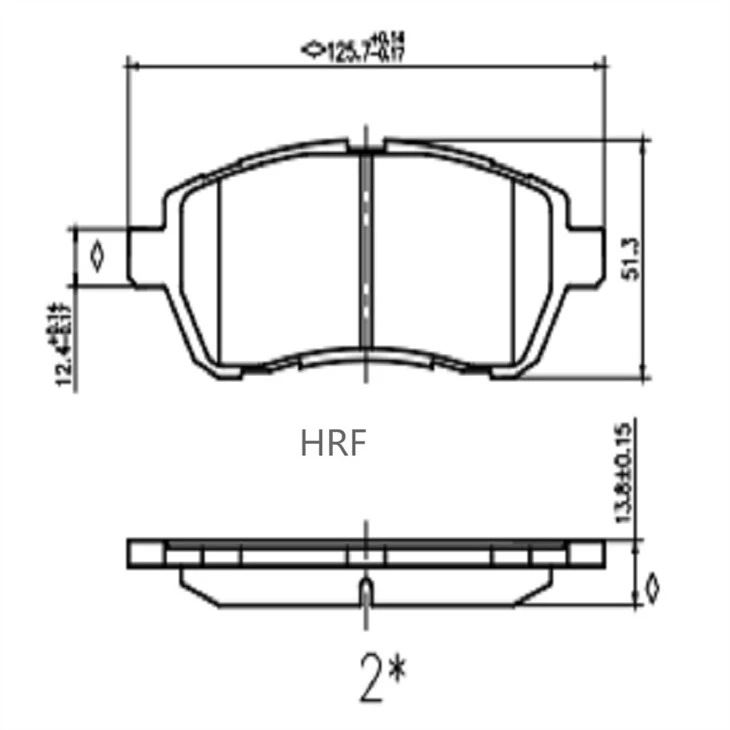
Automobile brake pads, also known as automobile brake skins, are friction materials fixed on the brake drums or brake discs that rotate with the wheels. When the vehicle brakes, the friction linings and friction blocks of the brake pads bear external pressure, and through friction with the brake drums or brake discs, the kinetic energy of the vehicle is converted into heat energy, thereby achieving the purpose of decelerating or stopping the vehicle. They are key components to ensure driving safety.
II. Classification
1. Classification by brake type:
◦ Disc brake pads: Currently widely used, common in various sedans, SUVs and other models. They have sensitive braking response and good heat dissipation performance, which can effectively avoid brake fade, and are suitable for urban road conditions with frequent braking.
◦ Drum brake shoes: Generally used in some trucks, buses and some low-end models. Drum brakes have a simple structure and low cost, but their heat dissipation is poor. Long-term braking is prone to heat fade, and the braking efficiency is slightly lower than that of disc brakes.
◦ Heavy-duty truck linings: Specifically designed for heavy-duty trucks, they need to withstand greater braking force and friction, and are usually made of more wear-resistant and high-temperature-resistant materials.
2. Classification by material:
◦ Semi-metallic brake pads: Made of metals such as copper and iron and other composite materials, they are relatively low in price and can provide good braking performance under various conditions. They are more common in high-performance cars and some mid-to-low-end models. However, their heat resistance and anti-aging properties are relatively weak, and their service life is short.
◦ Organic (non-asbestos organic or NAO) brake pads: Made of materials such as rubber, glass, carbon, and Kevlar fibers bonded with resin, they have the advantages of low noise and less dust, and provide better braking comfort. But during heavy braking, the wear rate may be faster.
◦ Ceramic brake pads: Composed of ceramic fibers, fillers, and binding resin, they have excellent braking performance, low noise, less dust, good heat dissipation, and a long service life. However, the cost is high, and they are generally suitable for high-end models.
III. Factors Affecting Performance
1. Driving habits: Frequent sudden braking and aggressive driving will make the brake pads bear greater friction and heat, accelerating wear. For example, frequent start-stop in urban congested road conditions will cause the brake pads to wear much more seriously than when driving on smooth highway road conditions.
2. Vehicle weight: Heavier vehicles have greater inertia and require greater braking force when braking, so the brake pads wear faster. For example, the replacement frequency of brake pads for trucks is usually higher than that for sedans.
3. Environmental conditions: When driving in mountainous terrain, the vehicle needs frequent braking to control the speed, and the brake pads will heat up due to long-term work, accelerating wear; in stop-and-go traffic environments, the brake pads will also work frequently, leading to increased wear.
4. Material quality: High-quality friction materials and advanced manufacturing processes can ensure that the brake pads have good performance and a long service life. Low-quality brake pads may have problems such as unstable braking performance, easy wear, and high noise.
IV. Signs of Wear
1. Squeaking or screeching: A high-pitched noise when braking may indicate that the brake pads have worn to a certain extent. Some brake pads are equipped with wear indicators, which will make such sounds when approaching the end of their service life.
2. Friction or metal collision noise: If there is a friction sound or metal scraping sound during braking, it is likely that the brake pads are severely worn, and the metal back plate is directly in contact with the brake disc or brake drum. At this time, the brake pads need to be replaced immediately, otherwise, other components such as the brake disc will be damaged.
3. Reduced braking performance: The vehicle's braking distance becomes longer, or the brake pedal feels soft. This may be due to worn brake pads or problems with other components of the braking system, which need to be inspected and repaired in time.
V. Replacement Cycle
The replacement cycle of brake pads is usually 30,000 to 70,000 miles (about 48,000 to 112,000 kilometers), but the actual replacement cycle will vary due to factors such as driving habits, vehicle type, and driving environment. For example, if you often drive aggressively or the vehicle often drives in mountainous areas, the replacement cycle of brake pads will be shortened; while for vehicles with a smooth driving style and good driving road conditions, the replacement cycle of brake pads may be extended.
VI. Selection Criteria
1. Friction coefficient: The friction coefficient is not necessarily the higher the better or the lower the better. Usually, at 100°C, it should be between 0.3 and 0.7. Choosing a friction coefficient the same as or slightly larger than the original factory of the vehicle can ensure the best braking effect.
2. High-temperature resistance: At high temperatures, the friction coefficient of the brake pads should not be too low, otherwise, it will affect braking safety. Generally, it is required that the friction coefficient is not less than 0.2 at 200°C.
3. Wear resistance: High-quality brake pads usually use new ceramic materials, etc., which have a long service life, can reduce the replacement frequency, and save costs.
4. Physical strength: Brake pads need to withstand pressure and shear force during processing and use to ensure that they will not deform or crack during braking.
5. Adaptability: New brake pads should be well run-in with the brake disc to ensure no gaps, avoiding jitter or abnormal noise during braking.
6. Comfort: Including braking feel, noise, dust, smoke, and peculiar smell. Good brake pads should provide a smooth braking feeling while reducing noise and dust.
7. Brand and enterprise strength: Choosing well-known brands, their product quality is usually more guaranteed. Brands with high sales volume often have higher cost performance, and you can refer to other users' evaluations and market reputation.
VII. Industry Status and Development Trends
China is a major country in automobile production and consumption, and the huge car ownership provides a broad market space for the brake pad industry. In recent years, with the continuous development of the automobile industry and consumers' attention to driving safety, the scale of the brake pad market has continued to grow. At the same time, the rise of new energy vehicles has also brought new opportunities and challenges to the brake pad industry. The braking system of new energy vehicles is different from that of traditional fuel vehicles, which puts forward higher requirements for the performance and quality of brake pads, prompting enterprises to increase R&D investment and launch more environmentally friendly, energy-saving, and high-performance brake pad products.
Shandong Huaruifeng Machinery Co., Ltd. has always paid attention to industry dynamics, continuously introduced advanced technologies and equipment, and improved product quality and performance. Our brake pad products use high-quality raw materials and undergo strict production processes and quality inspections to ensure that we provide customers with safe and reliable braking solutions. Whether you are an automobile manufacturer or an automobile maintenance enterprise, choosing our brake pad products means choosing a strong guarantee for driving safety.


