

Hot Expansion, Cold Fit – How a Brake Pad Factory Manages Thermal Growth for Safe Installation
Every material expands when heated and contracts when cooled. Brake pads are no exception. The friction material and backing plate have different coefficients of thermal expansion (CTE). When a pad heats up during braking, it grows – slightly in thickness, significantly in length and width. If the factory has not accounted for this growth, a pad that fits perfectly when cold may become too tight in the caliper bracket when hot, causing dragging, overheating, noise, or even a stuck brake. Conversely, a pad designed with too much cold clearance may rattle and wear unevenly. A professional brake pad factory engineers the pad's room‑temperature dimensions to achieve the correct fit at operating temperature – a critical balance often overlooked by low‑quality suppliers.
Why Thermal Expansion Matters
Brake pads operate in a wide temperature range – from below freezing on a winter morning to over 500°C during a mountain descent. The caliper bracket, usually cast iron or aluminum, also expands but at a different rate. The critical fit is the gap between the pad's steel backing plate and the caliper bracket's abutment surfaces (the channels that guide the pad).
· Too tight when hot – The pad binds, cannot retract, and drags on the rotor. This increases fuel/energy consumption, generates excess heat, fades the brakes, and wears both pad and rotor prematurely. In extreme cases, the pad may not release at all, causing a fire or loss of braking.
· Too loose when cold – The pad rattles over bumps (a common customer complaint). It may also shift during braking, leading to uneven wear, noise, and reduced pedal feel.
Coefficients of Thermal Expansion
Different materials expand at different rates (measured in µm/m·°C):
· Steel backing plate – CTE ~12 µm/m·°C. A 150‑mm long pad will grow about 0.9 mm when heated from 20°C to 500°C.
· Friction material (typical phenolic composite) – CTE varies widely from 20 to 50 µm/m·°C depending on resin, fiber, and filler content. High‑graphite pads expand more; high‑ceramic pads expand less.
· Cast iron caliper bracket – CTE ~11 µm/m·°C (similar to steel). Aluminum brackets expand more (~23 µm/m·°C).
The mismatch between pad and bracket can cause binding or loosening. A factory must know the CTE of both components and design the cold‑fit clearance accordingly.
How a Professional Factory Designs for Thermal Fit
1. CTE measurement – The factory uses a thermal mechanical analyzer (TMA) or dilatometer to measure the pad's expansion curve from 20°C to 600°C. This data is used to calculate the required cold clearance for each application.
2. Application‑specific tolerances – A pad for a heavy truck (high operating temperature) needs more cold clearance than a pad for a compact car. The factory maintains a database of target clearances by vehicle model.
3. Backing plate coating – Some factories apply a thin, compressible coating (e.g., rubber‑based or PTFE) to the plate edges. This coating compresses when the pad expands, acting as a thermal buffer and reducing binding risk.
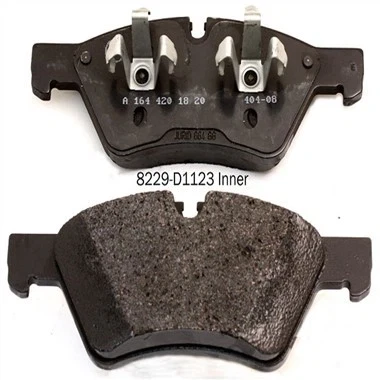
4. Anti‑rattle clips – Spring clips that hold the pad in the bracket can be designed to maintain tension across the expansion range. A quality factory tests clip retention force at high temperature.
Consequences of Ignoring Thermal Expansion
Low‑cost factories often copy dimensions from OE pads without verifying thermal behavior. Common problems include:
· Pad binding – The pad expands and locks in the bracket. The driver feels a pull to one side or a burning smell.
· Uneven wear – One pad wears faster than the other on the same axle because it cannot retract fully.
· Noise – A loose pad rattles; a binding pad may squeal as it drags.
· Premature rotor cracking – Dragging pads overheat the rotor, causing thermal cracks.
What Buyers Should Ask and Verify
When evaluating a brake pad factory, ask:
· Do you measure the coefficient of thermal expansion of your friction materials?
· How do you determine the correct cold clearance for each vehicle application?
· Do you use any anti‑binding coatings or treatments on backing plate edges?
· Have you ever had field complaints about pad dragging or rattling due to thermal fit issues?
Also request a cold fit test: install sample pads into a caliper bracket at room temperature. There should be a slight audible rattle (the pad should move freely but not excessively). Then heat the pad to 300°C (using an oven) and immediately check the fit again – the pad should still move, though with more resistance. If it binds completely, the design is flawed.
The Customer Conversation
As a distributor, you can educate customers about thermal expansion: "Our pads are engineered to maintain proper caliper clearance from cold start to the hottest stop. The slight cold rattle you feel is intentional – it means the pad will not drag when hot." This transparency builds trust and reduces unnecessary returns from customers who mistake intentional clearance for poor fit.
The Bottom Line
Thermal expansion is a physical reality that every brake pad must accommodate. A professional factory measures CTE, designs application‑specific clearances, and validates fit across the operating temperature range. Pads that ignore thermal growth will drag, rattle, or fail. When you source from a factory that masters thermal fit, your customers enjoy quieter, cooler, longer‑lasting brakes – from the first mile to the last.


