

Inside a Brake Pad Factory — The Overlooked Components That Determine Safety and Performance
Most brake pad discussions focus on friction material - ceramic versus semi-metallic, copper-free formulations, and friction coefficients. But inside a professional brake pad factory, engineers know that the friction compound is only half the story. Three often-overlooked components determine whether a pad delivers consistent, quiet, and safe braking over its entire service life. As a buyer, understanding these parts will help you separate premium factories from commodity producers.
Component 1: The Backing Plate – More Than Just Stamped Steel
The backing plate is the structural foundation of every brake pad. It transfers clamping force from the caliper piston to the friction material. A poor-quality backing plate can bend, rust, or lose its friction attachment - leading to pad separation, a catastrophic failure.
A professional factory pays attention to four backing plate details:
· Material grade – High-quality plates use cold-rolled steel (typically SPCC or equivalent) with thickness tolerances of ±0.1 mm. Inferior factories may use thinner or recycled steel that warps under heat.
· Surface preparation – Before bonding friction material, the plate must be cleaned, degreased, and often grit-blasted to create a mechanical key. Some factories also apply an adhesive primer.
· Claw or hook design – Many premium plates feature bent claws or perforations that mechanically lock the friction material in place, supplementing the resin bond.
· Corrosion coating – The non-friction side of the plate should receive a painted, powder-coated, or geomet coating to prevent rust. Rust can lift the friction material or cause caliper sticking.
Ask your factory supplier: What steel grade do you use for backing plates, and how do you test adhesion strength? A professional answer should reference shear testing (e.g., JASO C427 or SAJ JASO C427) with minimum values typically above 2.5 MPa.
Component 2: The Shim – Your Silent Defense Against Noise
Brake squeal is the number one complaint from end users. The primary solution? The shim - a multi-layer damping plate bonded to the back of the pad.
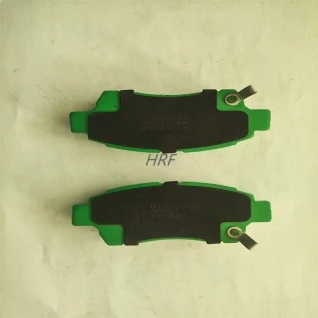
Low-cost factories often skip shims entirely or use a single-layer rubberized coating. Premium factories use:
· Multi-layer shims (typically 3–5 layers of rubber and steel) engineered to absorb specific vibration frequencies.
· Adhesive transfer tape that maintains bonding even at 400°C.
· Mechanical attachment (clips or pins) in addition to adhesive, preventing shim movement.
If a factory offers pads without shims or with generic single-layer shims, expect higher noise complaint rates. For quiet-running applications - especially EVs and luxury vehicles - insist on OE-style multi-layer shims.
Component 3: The Slot and Chamfer – Small Features, Big Impact
Look at a finished brake pad. You will see angled edges (chamfers) and often straight or curved grooves (slots). These are not decorative. Chamfers reduce vibration at the leading and trailing edges of the pad. Slots provide escape paths for gas, dust, and water that would otherwise create a slippery layer between pad and rotor.
A quality factory designs slots and chamfers specific to each vehicle application. A budget factory uses the same slot pattern for every pad - reducing performance. Ask whether the factory offers:
· Application-specific chamfer geometry (e.g., double chamfer for large SUVs, single chamfer for compacts).
· Slot width and depth control – Slots that are too shallow fill with debris; slots that are too deep weaken the pad.
· Slot placement – Avoiding the center of the pad to maintain structural integrity.
Practical Checklist for Buyers
When evaluating a brake pad factory, go beyond friction material. Request:
1. Backing plate adhesion test reports – Shear strength values and photos of failure mode (should be cohesive within friction material, not at the plate interface).
2. Shim specification sheets – Number of layers, temperature rating, peel strength.
3. Drawings showing chamfer angles and slot dimensions for your target part numbers.
The Bottom Line
A brake pad that looks identical on the outside can perform very differently depending on the backing plate, shim, and slot/chamfer design. Professional factories treat these components as critical design elements, not afterthoughts. By asking the right questions and verifying these details, you will source brake pads that stop quietly, last longer, and keep your customers safe - and coming back for more.


