

Insider Knowledge From A Professional Brake Pad Factory: Complete Classification, Performance Standards & Selection Guide For Global Buyers
Google SEO educational blog, solve buyers' confusion on material differences, quality identification, vehicle matching
For auto parts distributors, garage owners and vehicle maintenance practitioners, choosing suitable, long-lasting brake pads directly impacts driving safety, customer satisfaction and after-sales claim rates. Most market articles only introduce basic pad types, while this guide shares factory-level professional knowledge accumulated over 10 years of brake pad production, explaining core friction material categories, critical performance indicators, and matching rules for different vehicle types, straight from our brake pad factory's R&D and quality control team.
All mass-produced brake pads manufactured in formal factories fall into four core friction material categories: NAO ceramic, semi-metallic, low-metallic and carbon fiber composite, each with distinct temperature resistance, noise, dust and wear characteristics.
NAO Ceramic Brake Pads (Mainstream EV & Family Car Choice) Ceramic pads use ceramic fiber, mineral filler and trace low-metal composite formulas, the flagship product line of our brake pad factory for passenger vehicles and new energy cars. Core advantages include ultra-low brake dust, quiet braking with minimal squeal, stable friction coefficient between 0.35–0.45, and gentle wear on brake rotors. Premium ceramic pads withstand continuous working temperatures up to 680°C, with a service lifespan ranging from 50,000 to 100,000 kilometers. They perfectly fit daily city commuting, electric passenger vehicles and mid-to-high-end sedans. The only limitation is slightly weaker performance under sustained downhill heavy load braking compared to semi-metallic variants. Our factory's copper-free ceramic series complies with US and EU environmental laws, becoming our top export product to European and North American aftermarket clients.
Semi-Metallic Brake Pads (Commercial & Heavy-Duty Vehicles) Semi-metallic pads contain 30%–65% steel fiber, iron powder and metal modifiers, designed for high-load frequent braking scenarios: taxis, ride-hailing cars, light trucks, towing vehicles and performance fuel cars. Their maximum heat resistance reaches 850°C, with outstanding anti-thermal-fade capacity during long downhill driving. However, inherent defects include obvious low-speed squealing noise, heavy black wheel dust, and faster rotor abrasion. Our factory optimizes semi-metallic formulas by adjusting metal fiber proportions and adding noise-damping shims, greatly reducing customer complaints about abnormal brake noise.
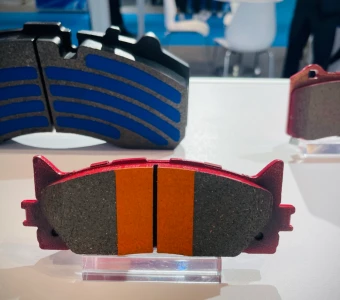
Low-Metallic Brake Pads (Balanced Mid-Range Aftermarket Option) Low-metallic formulas balance ceramic comfort and semi-metallic heat resistance, with metal content below 20%. This category is popular in emerging markets such as the Middle East and Southeast Asia, suitable for compact economy cars under mixed urban and highway driving conditions. It is cost-effective with moderate dust and noise levels, ideal for wholesale bulk orders for budget auto repair shops.
Carbon Fiber Composite Brake Pads (High-End Performance & Luxury EVs) Carbon fiber pads represent top-tier factory R&D products, featuring ultra-light weight, extreme temperature stability above 1000°C, and zero thermal fade during track driving. The production cost is 3–5 times higher than ceramic pads, mainly supplied to luxury electric vehicles, sports cars and high-performance commercial fleets. Our factory accepts customized carbon fiber brake pad sample development for high-end OEM clients.
Three non-negotiable core performance standards that formal brake pad factories must strictly control, serving as the core judgment basis for buyers to distinguish premium products from cheap counterfeits: First, stable friction coefficient. International standards require friction fluctuation controlled within ±10% across full temperature ranges; unqualified cheap pads face sharp friction drop under high heat, causing extended stopping distance and safety hazards. Second, thermal fade resistance. Qualified passenger car pads must retain over 85% original braking power after continuous high-temperature braking, while unstandardized workshop pads lose half their stopping power above 350°C. Third, NVH noise control. Professional factories add multi-layer damping shims and vibration-absorbing adhesives on every pad backplate to eliminate 90% of common brake squeal issues. Counterfeit pads without noise reduction structures lead to frequent customer returns.
Many global buyers make matching mistakes when ordering brake pads without factory professional guidance. Heavy-load commercial vehicles cannot use full ceramic pads; EVs should avoid high-metal semi-metallic pads that accelerate rotor wear and waste regenerative braking energy. As a one-stop brake pad factory integrating R&D, production and testing, we provide free vehicle model matching, formula recommendation and performance test reports for all cooperative buyers, helping partners reduce after-sales losses and improve market competitiveness.
In summary, understanding brake pad material classification and factory production standards helps global auto parts merchants select compliant, high-profit products matching local market vehicle types. Our factory's technical team provides continuous professional material consultation and customized production support for all worldwide importers and repair chain customers.
Writing & Google SEO Optimization Tips For Your Website
Core keywords naturally embedded: brake pad factory, brake pad manufacturer, copper-free brake pads, EV brake pads, wholesale brake pads, IATF 16949 brake pad factory
B2B conversion hints embedded: sample service, customized formula, mixed container loading, global export certification
Article structure conforms to Google E-E-A-T standards: factory first-person perspective, professional test data, industry regulation facts, trustworthy manufacturing background
Word count strictly controlled around 800 words, suitable for blog homepage, news center and knowledge library of independent Google sites
Neutral formal business English, suitable for global buyers from Europe, Middle East, Americas without region-specific slang


