

Industry Knowledge of Brake Pads (Shandong Huaruifeng Machinery Co., Ltd.)
Brake pads, as the core safety components of automotive braking systems, directly determine the reliability of vehicle deceleration and braking, serving as the "lifeline" for driving safety. Shandong Huaruifeng Machinery Co., Ltd. has been deeply engaged in the R&D and production of brake pads and brake shoes. With rigorous process control and adaptive design, we provide cost-effective braking solutions for commercial vehicles and passenger cars worldwide. Below is a comprehensive analysis of key industry information from four aspects: core knowledge, selection logic, technical trends, and Huaruifeng's advantages.
I. Core Structure and Working Principle of Brake Pads
Basic Structure
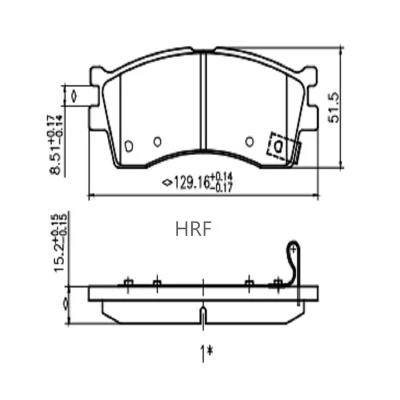
A brake pad mainly consists of three parts: steel plate, bonded thermal insulation layer, and friction block:
• Steel plate: Treated with anti-rust technology to ensure structural strength and durability.
• Thermal insulation layer: Made of non-heat-conducting materials, it blocks friction heat from transferring to the caliper and tires, preventing high-temperature failure.
• Friction block: Composed of friction materials and adhesives, it generates braking force through friction with the brake disc/drum during braking, which is the core functional area.
Working Principle
When the brake pedal is pressed, the hydraulic system drives the caliper to clamp the brake disc. The friction block rubs intensely against the brake disc (or brake drum of drum brakes), converting the vehicle's kinetic energy into thermal energy to achieve deceleration or parking. High-quality brake pads must maintain a stable friction coefficient under complex working conditions such as high temperature, high speed, and heavy load to avoid thermal fade and braking failure.
II. Main Types of Brake Pads and Their Application Scenarios
According to the friction material formula, brake pads can be divided into four mainstream types with significant performance differences and distinct application focuses:
Type Core Components Performance Advantages Limitations Application Scenarios
Semi-metallic Brake Pads 30%-65% metal powder (iron, copper, etc.) + organic fillers High temperature resistance (about 400℃), good wear resistance, and affordable price High noise, much dust, and relatively large wear on brake discs Commercial vehicles, heavy-duty vehicles, economical passenger cars, suitable for frequent braking conditions
Low-metallic Brake Pads Metal content < 30% with optimized ratio of organic materials Balanced braking performance, lower noise than semi-metallic ones, and less wear Faster performance attenuation at high temperatures Urban commuter passenger cars, suitable for mild driving scenarios
NAO (Non-Asbestos Organic) Brake Pads Resin, plant fiber, aramid fiber, etc. Quiet, stable braking, small wear on brake discs, and eco-friendly General high temperature resistance and shorter service life Urban commuter vehicles, new energy passenger cars, focusing on comfort and environmental protection
Ceramic Brake Pads Ceramic fibers, non-metallic minerals + a small amount of metal High temperature resistance (above 650℃), quiet and dust-free, stable friction coefficient, and long service life (50,000-100,000 km) Slightly slow low-temperature braking response and higher price Mid-to-high-end passenger cars, high-speed cruising vehicles, suitable for scenarios with high requirements for braking quality
III. Industry Technical Trends and Market Pattern
Core Technical Trends
1. Green and Eco-friendly: Asbestos-free and copper-free have become the industry consensus. The EU has introduced copper-free regulations, and leading domestic enterprises have achieved mass production of copper-free ceramic formulas to reduce heavy metal pollution.
2. High-end Performance: The application of ceramic-based and carbon-ceramic composites is expanding. Carbon-ceramic brake pads can withstand temperatures above 800℃ and weigh only 1/3 of traditional products, suitable for high-performance models.
3. Intelligence and Lightweight: R&D of low-drag brake pads adapted to new energy vehicles is accelerating to reduce energy consumption; the friction coefficient fluctuation is controlled within ±0.05 to improve braking linear response.
4. Digital Process: Automated production lines and simulation technology are widely used to ensure product consistency and stability.
Market Pattern
The global brake pad market size is expected to reach RMB 314.541 billion by 2032, with a compound annual growth rate of 4.2%. The Chinese market shows echelon differentiation:
• First Echelon: Domestic leaders (such as Gold Kirin, Xinyi Braking) and international giants (Brembo, TRW), occupying the OEM supporting and high-end after-sales markets.
• Second Echelon: Regional advantageous enterprises (such as Huaruifeng), focusing on the commercial vehicle and mid-low-end passenger car markets, seizing market share with cost-effectiveness and customized services.
• Small and Medium-sized Brands: Concentrated in the low-end after-sales market, competing mainly on price with uneven quality.
IV. Core Advantages of Shandong Huaruifeng Machinery Co., Ltd.
Huaruifeng has been deeply engaged in the braking field, focusing on "safety, reliability, and adaptability" to provide customized solutions for global customers. Our core advantages are as follows:
1. Full Product Range: Mainly engaged in brake pads and brake shoes, covering four major formulas: semi-metallic, low-metallic, NAO, and ceramic. Suitable for various models such as commercial vehicles, passenger cars, and engineering machinery, we can meet the regulatory requirements of different countries and regions (such as EU ECE R90, US FMVSS 135).
2. Strict Quality Control: From raw material procurement to finished product delivery, we have 12 testing procedures. The friction coefficient is stable at 0.35-0.45, and the high temperature resistance reaches above 600℃ to ensure braking safety.
3. Customized R&D Capability: According to the needs of foreign trade customers, we can quickly adjust product formulas and sizes to adapt to the braking systems of different models, and provide English technical documents and after-sales support.
4. Cost-effective Advantage: Relying on the industrial cluster advantage of Weifang, Shandong, we optimize supply chain management to provide customers with highly competitive prices on the premise of ensuring quality, suitable for bulk procurement and long-term cooperation.
V. Key Points for Brake Pad Selection and Maintenance
Core Selection Indicators
1. Friction Coefficient: Conventional models choose the range of 0.35-0.45 to avoid braking failure caused by being too high or too low.
2. High Temperature Resistance: Select according to driving scenarios; for frequent high-speed or mountain road driving, choose ceramic brake pads with high temperature resistance ≥600℃.
3. Adaptability: Strictly match the brake pad model and size of the vehicle to avoid affecting braking effect due to improper installation.
4. Certification Standards:
Priority should be given to products that have passed international certifications such as ECE and FMVSS to ensure compliance with safety regulations.
Daily Maintenance Suggestions
1. Regularly check the thickness of the brake pads; replace them in time when the thickness of the friction block is ≤3mm.
2. Avoid sudden braking and continuous braking to reduce brake pad wear and thermal fade.
3. After replacing new brake pads, run-in for about 200 kilometers to achieve the best braking effect.
4. When replacing brake pads, check the condition of the brake disc synchronously; if the wear is severe, replace it together to avoid affecting braking performance.
Shandong Huaruifeng Machinery Co., Ltd. always takes "guarding every braking safety" as its mission, continuously invests in R&D and process upgrading, provides high-quality brake pad products and professional technical services for global customers, and helps partners gain advantages in market competition.


