

Detailed Explanation of Common Types and Characteristics of Brake Pads
The classification of brake pads is mainly based on two major dimensions: adapted braking method and core friction material. Different types of brake pads have significant differences in structural design, performance, and application scenarios, which directly affect the vehicle's braking effect, comfort, and service life. The following is a detailed analysis from these two classification dimensions:
I. Classification by Adapted Braking Method
Automotive braking systems are mainly divided into two types: "disc braking" and "drum braking". The corresponding brake pads are also divided into disc brake pads and drum brake pads. These two types are designed for different braking needs in terms of structure and performance.
(I) Disc Brake Pads
1. Structural Features
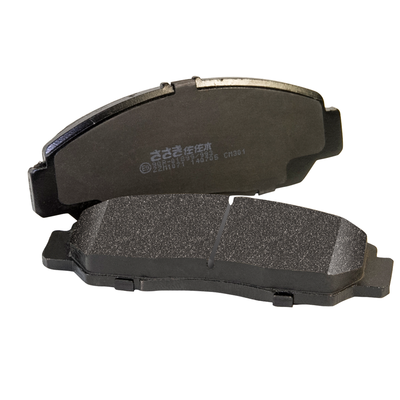
Core Composition: Composed of two independent friction blocks, installed inside the brake caliper. The back of each friction block is attached to a metal backing plate (to enhance structural strength).
Working Coordination: When braking, the piston inside the brake caliper is pushed by hydraulic pressure, pressing the friction blocks on both sides tightly against the rotating brake disc (exposed on the outside of the wheel, visible to the naked eye), and braking is achieved through "clamping-type" friction.
Auxiliary Design: The brake disc is exposed and mostly equipped with ventilation grooves/heat dissipation holes for fast heat dissipation; the surface of the friction blocks of some high-end models is grooved or chamfered to reduce dust and noise during braking.
2. Performance Advantages
Fast Braking Response: The contact area between the friction blocks and the brake disc is uniform, and the air flow is strong when the brake disc rotates, which can quickly build up braking force. The "instant response" feedback during emergency braking is more obvious.
Good Resistance to Fade: In high-temperature environments (such as continuous downhill driving or high-speed emergency braking), the heat dissipation efficiency of the brake disc can effectively prevent the friction material from failing due to overheating, and the braking force attenuation range is small (usually less than 15%).
Convenient Maintenance: The brake disc and friction blocks are exposed, so the wear condition can be directly observed through the gap of the wheel, and it is not necessary to disassemble the wheel hub to determine whether replacement is needed.
3. Application Scenarios
Main Adaptation: More than 90% of passenger cars (sedans, SUVs, MPVs), especially mid-to-high-end models and high-performance sports cars (such as BMW 3 Series, Porsche 911).
Special Needs: Light commercial vehicles (such as pickups, micro-vans) that require high braking stability, and vehicles that often drive on mountain roads or highways.
(II) Drum Brake Pads
1. Structural Features
Core Composition: Composed of a pair of arc-shaped brake shoes (friction material attached to a metal shoe frame), installed inside the closed brake drum (the brake drum rotates synchronously with the wheel).
Working Coordination: When braking, the piston of the wheel cylinder pushes the brake shoes to "expand" outward, making the friction material closely fit the inner wall of the brake drum, and braking force is generated through "expansion-type" friction.
Auxiliary Design: The closed structure of the brake drum is prone to dust accumulation, so some models are equipped with dust covers on the drum brakes; the contact area between the brake shoes and the brake drum is larger, which is suitable for transmitting large torque.
2. Performance Advantages
Large Braking Torque: The contact area between the arc-shaped brake shoes and the brake drum is 30%~50% larger than that of disc brake pads, which can provide stronger braking force in low-speed and heavy-load scenarios (such as when a truck is going downhill with a full load).
Lower Cost: Simple structure, low difficulty in production process, less raw material consumption, and the price is 20%~40% lower than that of disc brake pads of the same specification.
Good Dust Resistance: The closed brake drum can reduce the erosion of friction materials by sand, mud, and rainwater, making it suitable for use in harsh road conditions with mud and dust.
3. Application Scenarios
Main Adaptation: Medium and heavy-duty commercial vehicles (such as trucks, buses, muck trucks), and low-end passenger cars sensitive to cost (such as some micro-cars, old-fashioned vans).
Special Needs: Motorcycles (especially cruiser motorcycles, heavy-duty motorcycles), and some engineering machinery vehicles (such as forklifts, tractors).
II. Classification by Core Friction Material
Friction material is the core that determines the performance of brake pads. Different material formulas directly affect wear resistance, high-temperature resistance, and braking comfort. They are mainly divided into four categories: organic, semi-metallic, ceramic, and NAO (non-asbestos organic).
(I) Organic Brake Pads
1. Material Composition
Basic Components: With organic fibers (glass fibers, aramid fibers, flax fibers) as the reinforcing framework, phenolic resin as the binder, and friction modifiers such as graphite and sulfides added (metal content < 5%).
Environmental Characteristics: Does not contain harmful substances such as asbestos and heavy metals, and has low emissions of volatile organic compounds (VOCs) during the production process.
2. Performance Characteristics
Advantages:
Low Braking Noise: The friction material is relatively soft, and the "impact feeling" when in contact with the brake disc is weak. The noise during daily braking is less than 50 decibels (similar to the sound of normal conversation).
Protection for Brake Disc: Low wear rate on the brake disc, which can extend the service life of the brake disc (30%~50% lower than that of semi-metallic brake pads).
Good Low-Temperature Performance: In the low-temperature range of -20℃~150℃, the friction coefficient is stable (0.35~0.45), suitable for short-distance urban commuting (frequent starts and stops).
Disadvantages:
Poor High-Temperature Resistance: When the temperature exceeds 200℃, the friction coefficient will decrease by 20%~30%, and "brake fade" is likely to occur (such as continuous emergency braking at high speed).
Weak Wear Resistance: The service life under normal driving is only 30,000~50,000 kilometers, which is 40%~60% shorter than that of ceramic brake pads.
3. Application Scenarios
Adapted Models: Ordinary passenger cars for urban commuting (such as Toyota Corolla, Volkswagen Lavida), especially for female car owners and novice car owners (sensitive to noise).
Driving Scenarios: Mainly driving on urban roads, with an annual driving mileage of < 10,000 kilometers, and no aggressive driving habits (few emergency brakes, few high-speed driving).

(II) Semi-Metallic Brake Pads
1. Material Composition
Basic Components: With metal fibers (steel fibers, copper fibers, iron fibers) as the main reinforcing material (metal content 30%~60%), ceramic powder and graphite as friction modifiers, and phenolic resin still used as the binder.
Structural Characteristics: Metal fibers are interwoven to form a "rigid framework", which improves the strength and thermal conductivity of the brake pads.
2. Performance Characteristics
Advantages:
Strong Wear Resistance: The wear resistance of metal fibers is 2~3 times higher than that of organic fibers, and the service life under normal driving can reach 50,000~70,000 kilometers.
Good High-Temperature Resistance: In the medium and high-temperature range of 200℃~400℃, the friction coefficient is stable (0.4~0.5), suitable for high-speed driving and mountain roads (frequent braking).
High Cost-Effectiveness: Better performance than organic brake pads, and the price is only 50%~70% of that of ceramic brake pads, making it the mainstream choice in the current market.
Disadvantages:
High Braking Noise: When metal fibers rub against the brake disc, it is easy to produce "sharp abnormal noise" (60~80 decibels, similar to the sound of nails scratching glass), which is more obvious in low-temperature environments.
Wear on Brake Disc: The high hardness of metal components leads to a 40%~60% higher wear rate on the brake disc than that of organic brake pads, and long-term use may cause "grooves" on the brake disc.
3. Application Scenarios
Adapted Models: Economical passenger cars (such as Geely Emgrand, Changan Eado), household SUVs (such as Haval H6, Changan CS75), and some light commercial vehicles (such as Wuling Hongguang PLUS).
Driving Scenarios: Annual driving mileage of 10,000~30,000 kilometers, combining urban commuting and high-speed long-distance driving, with a "stable" driving style (occasional emergency brakes).
(III) Ceramic Brake Pads
1. Material Composition
Basic Components: With ceramic fibers (alumina ceramics, silicon carbide ceramics) and ceramic particles as the core, combined with a small amount of copper fibers (to improve thermal conductivity) and high-temperature resin binder (metal content < 10%).
Process Characteristics: Need to go through "high-temperature sintering" treatment (sintering temperature 800℃~1200℃) to make ceramic particles and fibers closely integrate to form a high-density structure.
2. Performance Characteristics
Advantages:
Excellent High-Temperature Resistance: In the high-temperature range of 400℃~600℃, the friction coefficient has almost no attenuation (0.45~0.55), suitable for aggressive driving (such as track experience, mountain road drifting).
Low Noise and Low Dust: The ceramic material has a fine texture, and the "resonance" when rubbing against the brake disc is weak, with noise less than 45 decibels; the amount of friction dust is 80%~90% less than that of semi-metallic brake pads, so the wheel hub is not easy to get dirty.
Ultra-Long Service Life: The service life under normal driving can reach 70,000~100,000 kilometers, which is 2~3 times that of organic brake pads; the wear rate on the brake disc is low (equivalent to that of organic brake pads).
Disadvantages:
High Cost: High raw material prices and complex production processes, and the price is 80%~120% higher than that of semi-metallic brake pads of the same specification.
Average Low-Temperature Performance: In low-temperature environments below -20℃, the friction coefficient will decrease by 10%~15%, and the braking response is slightly slow at the initial stage of cold start.
3. Application Scenarios
Adapted Models: High-end passenger cars (such as Mercedes-Benz E-Class, BMW 5 Series), high-performance sports cars (such as Audi RS6, Tesla Model S Plaid), and luxury SUVs with high requirements for braking quality (such as Porsche Cayenne).
Driving Scenarios: Often driving at high speed or on mountain roads, or having aggressive driving habits (frequent rapid acceleration and emergency braking), with an annual driving mileage of > 20,000 kilometers.
(IV) NAO Brake Pads (Non-Asbestos Organic Brake Pads)
1. Material Composition
Basic Components: With high-performance organic fibers (aramid fibers, polyester fibers) as the reinforcing material, combined with mineral fibers and glass fibers (without asbestos), and friction modifiers such as graphite and silica added (metal content < 10%).
Technical Positioning: It is an "upgraded version of organic brake pads". By optimizing the fiber ratio and additives, it makes up for the shortcomings of organic brake pads in wear resistance and high-temperature resistance.
2. Performance Characteristics
Advantages:
Good Braking Stability: In the temperature range of -10℃~300℃, the friction coefficient has small fluctuations (0.38~0.48), which meets both low-temperature commuting and medium-high speed braking needs.
Excellent Environmental Protection: Completely free of asbestos, and the content of heavy metals (lead, mercury, cadmium) meets the EU RoHS standard, making it suitable for regions with high environmental requirements (such as Europe and Japan).
Balanced Comfort: Noise is less than 55 decibels, and the wear rate on the brake disc is 20%~30% lower than that of semi-metallic brake pads, achieving a balance between "silence" and "durability".
Disadvantages:
Medium Wear Resistance: The service life is 40,000~60,000 kilometers, which is 30%~40% shorter than that of ceramic brake pads.
Low High-Temperature Limit: When the temperature exceeds 350℃, the friction coefficient will decrease by 15%~25%, which is not suitable for extreme high-temperature scenarios (such as continuous braking on the track).
3. Application Scenarios
Adapted Models: Passenger cars that focus on environmental protection and comfort (such as Honda Civic, Nissan Sylphy), and models exported to European and American markets (needing to meet local environmental regulations).
Driving Scenarios: Combining urban commuting and high-speed long-distance driving, with a "gentle" driving style, and having requirements for environmental protection and braking smoothness (such as family cars).


