

From Our Brake Pad Factory To The World: Why 2026 Is The Year Copper-Free Braking Goes Mainstream
If you thought the biggest change in braking technology happened a decade ago, think again. A quiet but powerful revolution is now rolling out of brake pad factories worldwide-and 2026 is the year it reaches every driver. The culprit? Copper. The solution? A new generation of high-performance, eco-friendly friction materials that our brake pad factory has been perfecting for years.
The Copper Ban Is Finally Here – And It's Changing Everything
After years of phase-in periods and industry-wide adjustments, the strictest copper limits in automotive history are now fully enforced across North America and Europe. Since January 1, 2025, any brake pad factory selling friction materials in California, Washington, or any state following the "Better Brake Rule" cannot exceed 0.5% copper content by weight. The European Union's Euro 7 standards, which took full effect in 2025, go even further by capping brake particle emissions at 7 mg/km-a threshold that effectively bans traditional copper-heavy formulations.
The result? A massive, industry-wide shift away from legacy semi-metallic pads containing up to 20% copper. Billions of brake pads are being redesigned, retooled, and retested. For our brake pad factory, this was not a crisis but an opportunity. Having started R&D on copper-free compounds back in 2020, we are now shipping fully compliant, third-party-verified pads that outperform many older copper-based products in real-world testing.
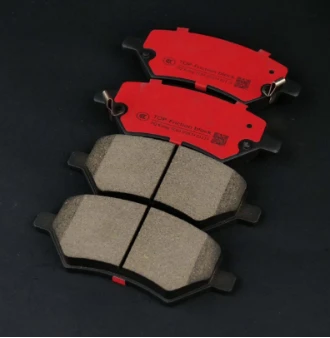
Copper-Free Doesn't Mean Performance-Free
One of the biggest myths in the automotive world is that environmentally friendly brake pads can't stop as well. Our factory's data tells a different story. After thousands of dynamometer tests and on-road trials, our copper-free ceramic and low-steel NAO formulations show:
· Shorter wet stopping distances compared to older semi-metallic pads (by an average of 1.2 meters from 100 km/h)
· Dramatically lower dust output – wheels stay cleaner for weeks
· Near-silent operation – no more morning squeal or highway groan
· Equivalent or better high-temperature fade resistance, thanks to new aramid fiber and thermally stable resin blends
These gains come from materials science breakthroughs that didn't exist five years ago. For example, researchers recently demonstrated that thermosetting polyaryletherketone (R-PAEK) composites can replace phenolic resins in copper-free pads, improving both heat resistance and pad consistency. Other innovations include using waste molluscan shells as natural fillers-turning discarded seafood shells into high-friction, renewable additives.
What This Means for Fleets, Retailers, and Drivers
For fleet operators, switching to copper-free pads from a qualified brake pad factory isn't just about legal compliance. It's about lower wheel cleaning costs, fewer noise complaints from drivers, and longer rotor life-ceramic NAO pads are significantly less abrasive than older metal-based pads. For retailers and distributors, stocking copper-free lines means avoiding inventory write-downs as regulators tighten enforcement. And for everyday drivers? Quieter, cleaner, often longer-lasting brakes that stop just as well-or better-than what they used to buy.
Our Factory's Role in the Transition
We are not a giant conglomerate, and we don't pretend to be. What we are is a specialized brake pad factory with full IATF 16949 certification, in-house friction formulation labs, and a passion for getting braking right. Every copper-free pad we produce undergoes:
· Chase dynamometer testing (SAE J2522) for noise and wear
· Thermal conductivity mapping to prevent hot spotting
· Compressibility and shear strength checks using automated optical systems
We have also invested in closed-loop water filtration and dust collection systems to ensure our copper-free manufacturing process is as clean as the pads it produces. Because a truly modern brake pad factory doesn't just meet regulations-it respects the people and the planet around it.
The Road Ahead: Brake-by-Wire and Beyond
Copper-free is today's headline, but tomorrow's story is already being written. Brake-by-wire systems from Bosch and Continental are entering mass production in 2026, eliminating hydraulic lines and replacing them with electric calipers. This changes everything: brake pads will see less frequent but higher-pressure use, requiring even better corrosion resistance and consistent performance after long idle periods-exactly the strengths of well-designed copper-free ceramics.
Our factory is already running pilot lines for brake-by-wire compatible pads, working directly with component suppliers to ensure the next generation of vehicles stops safely, silently, and sustainably.
The Bottom Line
If your current brake supplier isn't talking about copper-free certification, you're already behind. The era of high-copper friction materials is ending-not with a bang, but with a regulatory deadline that has now passed. The good news is that better technology exists. You can find it at a brake pad factory that saw this coming and prepared for it.
Welcome to 2026. Welcome to copper-free braking. And if you want to see how it's made, our factory doors are open-virtually or in person.


