

Brake Pad Industry Knowledge Popularization: A Key Component Related to Driving Safety
In the vast system of auto parts, brake pads are one of the core components ensuring driving safety, and their performance and quality directly affect the braking effect of vehicles and the life safety of drivers and passengers. With the rapid development of the automotive industry and the growing emphasis on driving safety among consumers, the brake pad industry is also constantly innovating and advancing.
I. Working Principle and Importance of Brake Pads
A car has kinetic energy when driving. The working principle of brake pads is to generate friction with the brake disc, converting the vehicle's kinetic energy into heat energy, thereby slowing down or stopping the vehicle. When the driver steps on the brake pedal, the piston inside the brake caliper will press the brake pad tightly against the high-speed rotating brake disc under hydraulic action. The friction between the two prevents the brake disc from rotating, and then realizes vehicle braking. From the perspective of the physics formula, friction force (f) is equal to the product of the friction coefficient (μ) and the normal pressure (n) on the friction surface in the vertical direction, i.e., f=μn. The friction coefficient (μ) between the brake pad and the brake disc, as well as the force (n) exerted by the brake caliper piston on the brake pad, jointly determine the magnitude of the braking force. An excellent-performing brake system must be able to provide stable, sufficient and controllable braking force. Good hydraulic transmission and strong heat dissipation capacity are also indispensable to avoid hydraulic failure and brake fade caused by high heat.
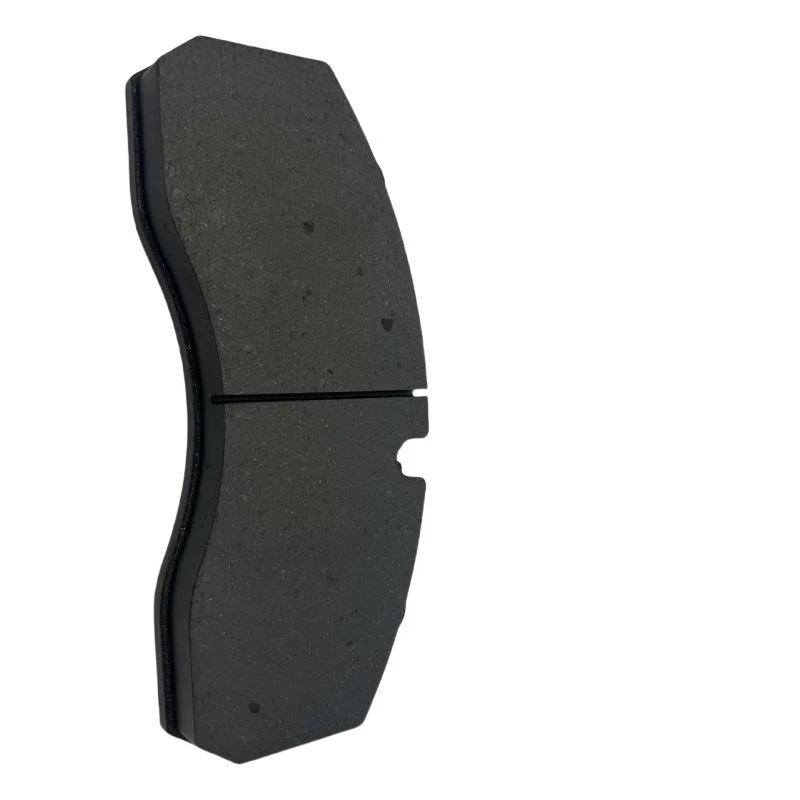
II. Types and Characteristics of Brake Pads
(I) Classification by Material
1. Semi-metallic brake pads: This type of brake pad is relatively common, and many cars are equipped with semi-metallic brake pads as original equipment when leaving the factory. It contains metal fibers and particles inside to enhance strength. It performs well in temperature control and heat dissipation. However, in low-temperature environments, due to high braking pressure, it may cause wear on the surfaces of the brake disc and brake drum, and generate noise. The friction coefficient is generally around 0.38, and the service life is relatively short. Some semi-metallic brake pads with high friction coefficient are prone to generate noise during braking and are widely used in Japanese cars.
2. Low-metallic brake pads: They are similar in appearance to semi-metallic brake pads but have a lower metal content. They effectively solve the problem of brake drum wear and produce less noise during braking. However, the service life of the brake pads is slightly shorter than that of semi-metallic ones.
3. Ceramic brake pads: Made by mixing ceramic fibers with other fibers and solidifying them with organic binders. They have many advantages, such as high hardness, good wear resistance, less dust, no corrosion to wheel hubs, no noise and environmental protection. Their thermal fade performance is better than that of semi-metallic ones, and they are quite popular in the European, American and Japanese markets. However, ceramic brake pads produced by different manufacturers have large price differences due to different raw materials. Really high-quality ceramic brake pads containing aramid fibers have more advantages in service life and performance, and their prices are relatively higher.
4. Carbon fiber brake pads: Widely used in the aerospace field, they have extremely strong thermal conductivity and excellent high-temperature resistance. They are not easy to fail even after long-term braking, cause little wear to the brake disc, have a long service life, high power absorption per unit area and light specific gravity. However, they are expensive and are mostly used in aircraft, as well as high-end foreign sports cars and racing cars.
5. Non-metallic brake pads: Generally do not contain metal components, and mostly use fiber materials such as aramid and glass fiber. Due to different product formulas and processes of different manufacturers, their performance varies.
(II) Classification by Brake Type
1. Disc brake pads: Can provide efficient and stable braking effect for vehicles, and are commonly used in various sedans.
2. Drum brake shoes: With the advantage of low cost, they are mostly used in large vehicles.
3. Truck brake linings: Play a key role in the braking system of large trucks.
III. Performance Indicators of Brake Pads
1. Braking performance: Refers to the braking capacity of the brake pad under normal braking conditions (when the braking temperature is low), i.e., the friction coefficient. A higher friction coefficient is not necessarily better; instead, a balance should be achieved in comprehensive performance to meet the overall vehicle design requirements.
2. Fade performance: Under road conditions that require continuous braking, such as downhill on mountain roads, the brake works frequently, and the temperature rises rapidly. The brake disc may reach a high temperature of 400-500℃ or even above 700℃. At this time, the braking capacity of the brake pad will deteriorate, and the braking distance will increase. This phenomenon is called "fade". Naturally, the smaller the fade rate, the better. High-quality brake pads have a very small fade rate or even no fade, while some inferior products fade seriously and almost lose their braking capacity at high temperatures.
3. Recovery performance: It is an important indicator to measure the quality of brake pads, referring to whether the brake pad that has experienced high-temperature fade can quickly restore its original braking performance when the temperature drops.
4. Wear: It includes not only the wear of the brake pad itself but also the wear of the brake disc. During the braking process, high-quality brake pads will form a protective film on the friction surface of the brake disc, reducing the wear of the brake disc; inferior brake pads contain a large number of hard spots and impurities, which will scratch many grooves on the surface of the brake disc and accelerate the wear of the brake pad and brake disc.
5. Noise: In the current era where environmental protection and driving comfort are emphasized, this is an important indicator. There are many factors causing braking noise, and the brake pad is one of them. It is generally believed that brake pads with too high hardness are prone to generate noise.
6. Other performance indicators: They also include shear strength, hardness, compression rate, thermal expansion, water absorption, adhesion, etc

.
IV. Development Trends of the Brake Pad Industry
(I) Technological Innovation Drives Product Upgrading
With the rapid development of new energy vehicles, higher requirements have been put forward for brake pads. New energy vehicles have large torque and fast start-up speed, and the energy recovery system and traditional brake system work together during braking. This requires brake pads to have better thermal stability, wear resistance and lightweight characteristics. For example, the development of new materials and optimization of formulas can improve the performance of brake pads under different working conditions. At the same time, the technology of intelligent brake pads is also constantly advancing. Embedded sensors can monitor the thickness of brake pads in real time, laser grooving design can improve water drainage and shorten the braking distance on wet roads, and gradient material technology can balance the initial running-in and durability.
(II) Environmental Regulations Promote Green Transformation
Global environmental regulations are becoming increasingly strict, putting forward higher standards for the emission of harmful substances in the production process of brake pads and the environmental performance of products. For example, the REACH Regulation of the European Union restricts the use of certain harmful substances in the production of brake pads. This has prompted enterprises to develop green technologies such as copper-free formulas and low-noise formulas, reduce heavy metal pollution, and produce more environmentally friendly brake pad products to meet market demand and regulatory requirements.
(III) Market Competition and Changes in Brand Pattern
The brake pad market is highly competitive. There are not only internationally renowned brands such as Bosch and Continental AG but also many domestic enterprises actively participating in the competition. Shandong Huaruifeng Machinery Co., Ltd. is one of them. Founded in 2011, it is affiliated to Qingdao Huarui Group, covering an area of 200,000 square meters with an initial investment of 160 million yuan. It currently has 5 production lines, with an annual production capacity of 6 million sets and more than 1,200 product models. It adopts 100% one-time molding molds to ensure product quality and precision. The company has more than 600 employees, including 65 technical backbones, and the proportion of personnel with college education or above is about 35%, with strong R&D capabilities. The company has developed more than 80 products in 5 major series, and has reached supporting cooperation with many domestic original equipment manufacturers (OEMs) such as Xinjiang Goldwind Science & Technology, FAW Group, and SAIC Group. Its products are in short supply. In the future, with the intensification of market competition, brand building and technological innovation will become the key for enterprises to stand out.
In conclusion, driven by technological innovation, environmental requirements and market competition, the brake pad industry is developing towards the direction of high performance, green environmental protection and intelligence. When choosing brake pads, consumers should comprehensively consider factors such as vehicle type, driving habits and usage environment, and select suitable products to ensure driving safety. At the same time, brake pad manufacturers also need to continuously increase R&D investment, improve product quality and performance, adapt to the development trend of the industry, and gain a foothold in the fierce market competition.


