

Condensed Structural Analysis of the Brake Pad Industry Chain
The brake pad industry has formed a closed-loop chain covering upstream raw material supply, midstream production, and downstream application. All links are interconnected, and their synergy determines the industry's competitiveness.
1. Upstream: Raw Material Supply Layer
This layer directly impacts brake pad performance, cost, and production capacity, focusing on three core raw material categories:
Metal Materials: Steel (for backplates, 40%-50% of a brake pad's weight) is dominated by domestic giants like Baosteel (70%+ market share). Copper costs rose 18% in 2024 due to new energy vehicle demand. High-end ultra-fine metal powders still rely on imports.
Non-Metal Materials: Rubber supply is climate-sensitive (e.g., 12% production drop in Thailand, 2023). Ceramic fibers (for high-end pads) have 85% domestic localization. Phenolic resins (binders, 15%-20% of raw materials) meet mid-to-high-end needs.
Fiber Materials: Domestic T700 carbon fiber is mass-produced but 20% costlier than Japan's Toray. Para-aramid (for NAO pads) covers mid-to-low-end demand; high-end variants are imported.
Key Influences: Policy-driven steel structure optimization, international price fluctuations (e.g., 12% hike in imported carbon fiber, 2024), and growing localization of high-end fibers.
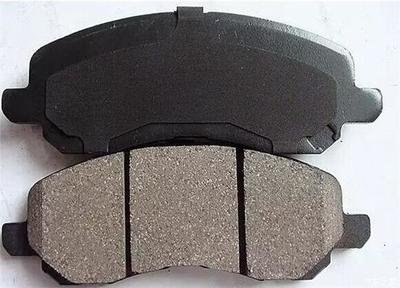
2. Midstream: Production and Manufacturing Layer
This core link transforms raw materials into products, with focus on:
Core Processes: Digital design (AutoCAD/FEA) and precision mold manufacturing (±0.01mm accuracy). Automatic mixing (±2% error) and molding (compression for semi-metallic/NAO pads; sintering for powder metallurgy). Post-processing (robot lines boost efficiency 3x) and testing (per SAE J2707).
Tech Upgrades: 85% automation rate in leading firms (2024), MES for efficiency (+20%) and defect reduction (-30%). 800℃ thermal fading control (<15% attenuation), 18% application of high-carbon composites, and mass-produced copper-free pads.
Cost & Quality: Scale production cuts costs (15%-20% lower for leaders); vertical integration reduces raw material costs (-10%). Full-process QC (IQC/IPQC/OQC) and ISO/TS 16949 certification.
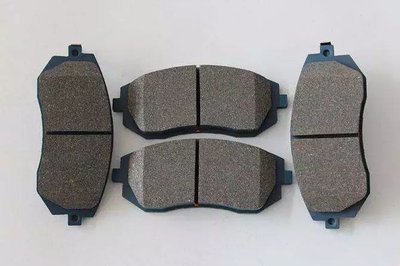
3. Downstream: Application and Service Layer
This terminal layer drives upstream/ midstream growth, covering:
OEM Market: Tied to auto production (95M units global, 2024; 18M new energy vehicles, +25% YoY). New energy vehicles need special pads (3.5B USD market, 2024). Joint development with automakers requires 1-2 years certification.
Aftermarket: 475.2B USD global scale (2024), driven by 1.52B global car ownership. Demand is decentralized (1-1.5 year replacement cycle). E-commerce sales grow 25% annually; domestic brands hold 38% market share (2024).
Regional Clusters: Yangtze/Pearl River Deltas hold 65% of China's capacity, with shorter supply chains (logistics cost -15%) and export advantages (40% of national exports). Clusters share R&D platforms (cost -20%) and shorten production cycles (7 days).


