

Brake Pads: The Core Guardians of Automotive Safety
I. The Structure and Working Principle of Brake Pads
As a core component of the automobile braking system, the structural design of brake pads directly affects the braking performance and safety. It usually consists of three parts: a high-strength steel backing, a heat insulation layer, and a friction material layer. The steel backing is treated with anti-rust coating to ensure long-term durability; the heat insulation layer uses special materials to block heat transfer and prevent the braking system from overheating; the friction layer is composed of various composite materials, which convert the kinetic energy of the vehicle into heat energy through friction with the brake disc or drum, realizing deceleration or parking.
The braking process follows the physical principle: when the driver steps on the brake pedal, the hydraulic system transmits the force to the brake caliper, pushing the brake pad to closely contact the rotating brake disc. At this time, the friction force (F = μN) becomes the key factor, where μ is the friction coefficient and N is the normal pressure. High-quality brake pads need to maintain a stable friction coefficient at different temperatures to ensure the reliability of the braking force.
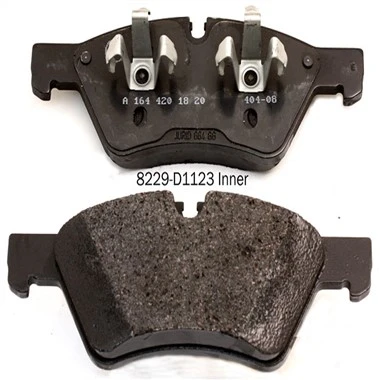
II. Material Classification and Performance Differences
The choice of brake pad materials determines their performance and applicable scenarios. Currently, the mainstream types include:
1. Semi-metallic brake pads: They contain metal fibers, have good high-temperature resistance, but produce relatively large noise and are likely to wear the brake disc. They are suitable for economy vehicles.
2. Low-metallic brake pads: By reducing the metal components, the problems of noise and dust are improved, and the thermal fade performance is enhanced. They are suitable for urban commuting.
3. Ceramic brake pads: Made of carbon fiber and ceramic composite materials, they have high-temperature resistance, low noise, and a long service life. However, the cost is relatively high, and they are mostly used in mid-to-high-end vehicles.
4. Carbon/carbon composite brake pads: Derived from aerospace technology, they have extremely high temperature resistance and are suitable for racing cars or high-performance vehicles.
Brake pads of different materials have significant differences in friction coefficient, thermal stability, and environmental friendliness. Consumers need to make a comprehensive choice according to the vehicle type, driving habits, and budget.
III. Manufacturing Process and Quality Control
The production of brake pads goes through a precise process:
1. Raw material mixing: Mix materials such as resins, fibers, and metal powders according to the formula ratio.
2. Hot pressing and forming: Press the mixture into shape under high temperature and pressure to form the friction block.
3. Curing treatment: Ensure the stability of the material structure and avoid deformation.
4. Precision machining: Punch and galvanize the steel backing, bond it with the friction block, and monitor the coating process through a furnace temperature tracker to ensure the anti-rust effect.
5. Performance testing: Test indicators such as the friction coefficient, wear rate, and noise to ensure compliance with national standards.
IV. Industry Development Trends and Challenges
The market size of brake pads in China has exceeded 30 billion yuan, with an annual growth rate of over 5%. The large number of automobiles in use provides stable support for the industry. With the popularization of new energy vehicles, higher requirements are put forward for the high-temperature resistance, lightweight, and environmental friendliness of brake pads. At the same time, the industry faces three major challenges:
1. Fluctuations in raw materials: The rising prices of steel and resins compress the profit margin.
2. Pressure of technological upgrading: The mid-to-high-end market is monopolized by international brands, and domestic enterprises need to break through technical barriers.
3. Environmental requirements: Asbestos-free and low-metal formulas have become the trend, increasing the research and development costs.
V. Replacement Cycle and Purchase Guide
The replacement cycle of brake pads is affected by driving habits and road conditions. It is generally recommended to check every 20,000 to 40,000 kilometers. Replace immediately if the following situations occur:
• The thickness of the brake pad is less than 3 millimeters (worn to the bonding layer);
• There is abnormal noise during braking or the steering wheel vibrates;
• The braking distance is significantly extended.
When purchasing, pay attention to:
1. Compatibility: Select the specification and model that match the vehicle type;
2. Certification standards: Give priority to products certified by ISO/TS 16949;
3. Brand and reputation: Well-known brands are more guaranteed in formula research and development and quality control;
4. Environmental friendliness: Choose environmentally friendly formulas with low dust and no heavy metals.
VI. Future Prospects
With the development of intelligent driving technology, brake pads will evolve towards intelligence. For example, wear sensors can be integrated to monitor the remaining life in real time. At the same time, the application of new technologies such as carbon-ceramic composite materials will further improve the braking performance and provide more reliable guarantee for driving safety.
Although brake pads are small, they bear the heavy responsibility of life safety. Understanding their principles, materials, and maintenance knowledge can not only extend their service life but also ensure the braking efficiency at critical moments. Choosing high-quality brake pads is not only a responsibility for one's own safety but also a contribution to road safety.


