

Smart Brake Pad Factory Upgrades Eco-Friendly Production Lines, Leading 2026 Low-Carbon Industry Transformation
In 2026, driven by global dual-carbon policies and stringent automotive component environmental regulations, the automotive brake pad industry is ushering in a comprehensive industrial upgrade centered on green manufacturing and intelligent production. A leading domestic brake pad factory has recently completed the full renovation of its intelligent eco-friendly production base, officially launching a new generation of copper-free, low-noise brake pad production lines, setting a new benchmark for high-quality and low-carbon development in the global brake pad manufacturing field. The factory's upgrade not only optimizes product performance to adapt to new energy vehicle braking needs but also drastically reduces production carbon emissions and pollutant discharge, responding to the increasingly strict international automotive environmental access standards.
In recent years, the global automotive industry has accelerated the transformation to electrification and intelligence, which has put forward higher technical requirements for brake pad products. Unlike traditional fuel vehicles, new energy vehicles widely adopt regenerative braking systems, leading to long-term light braking working conditions, which easily cause problems such as brake pad abnormal noise, rotor rust and unstable braking sensitivity. Meanwhile, countries around the world have continuously updated environmental protection regulations. The California SB 346 standard and China's automotive component green manufacturing specifications have clearly restricted the copper content in brake pads, forcing traditional manufacturing factories to abandon high-pollution and high-energy-consumption production processes and backward material formulas.
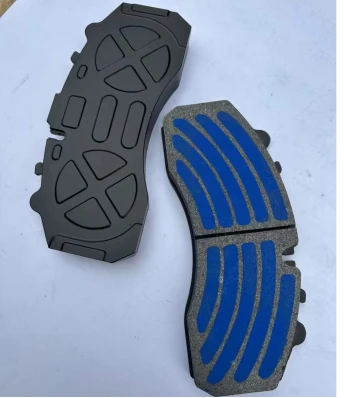
Facing industry pain points and policy changes, this brake pad factory has invested nearly millions of dollars in technological transformation in the past year, focusing on three core upgrade directions: environmental protection material research and development, intelligent production control, and clean production transformation. In terms of material innovation, the factory's R&D team independently developed a new low-metallic NAO (Non-Asbestos Organic) composite formula, completely eliminating heavy metal components such as excessive copper and lead. The new formula reduces metal wear debris by more than 40% compared with traditional semi-metallic brake pads, fully meeting the 2026 global low-copper environmental protection standards, and effectively solving the rotor rust and abnormal noise problems of new energy vehicles during daily light braking.
In terms of production intelligence, the factory has introduced fully automated batching systems, constant-temperature sintering equipment and digital quality inspection assembly lines. The whole production process from raw material proportioning, hot pressing forming, high-temperature curing to finished product flaw detection realizes full digital monitoring. The intelligent system can accurately control the friction coefficient density and curing temperature of each batch of products, reducing product dimensional tolerance to within 0.02mm. The product qualification rate has increased from 96.2% to 99.8%, and the production efficiency has been improved by 35%, greatly solving the inconsistency problem of manual production quality in traditional brake pad factories.
In terms of clean production, the factory has built a complete waste gas and dust recovery system. The sintering waste gas is purified by multi-stage filtration and activated carbon adsorption, with exhaust gas compliance rate reaching 100%. The production wastewater is recycled after sedimentation and filtration, realizing zero discharge of production wastewater. Statistics show that after the upgrade, the factory's annual carbon emission is reduced by more than 800 tons, and energy consumption per unit product is reduced by 28%, achieving a perfect balance between production capacity improvement and green environmental protection.
At present, the factory's new eco-friendly brake pad products have passed ISO/TS16949 automotive quality system certification and EU environmental certification, and have been successfully supplied to multiple new energy vehicle OEMs and global aftermarket dealers. Industry analysts said that with the continuous expansion of the new energy vehicle market and the tightening of environmental protection thresholds, green and intelligent manufacturing will become the core competitiveness of brake pad factories. This factory's upgrade and transformation provides a replicable development model for the industry, and will further promote the elimination of backward production capacity in the brake pad industry and accelerate the high-end, green and intelligent development of the whole industry chain. In the next stage, the factory plans to continue to increase R&D investment in carbon-ceramic composite brake pads to seize the high-end market of new energy luxury vehicles.


